
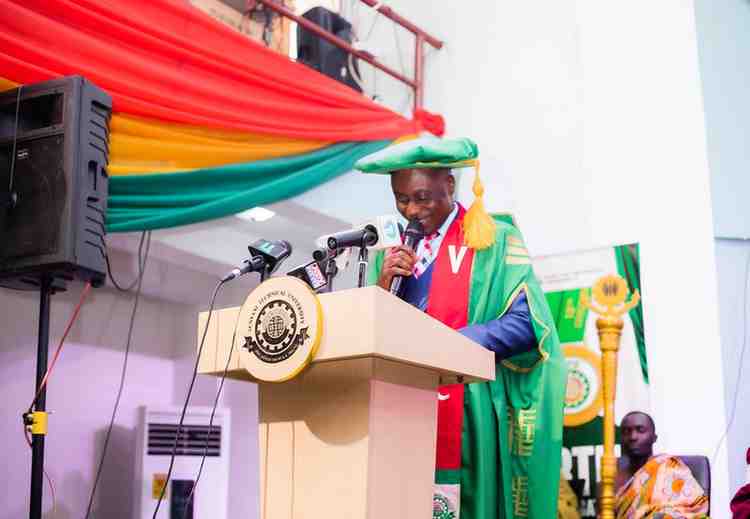
The Vice-Chancellor of Sunyani Technical University (STU), Ing. Prof. Kwadwo Adinkrah-Appiah, has reaffirmed the institution’s commitment to sustainable skills development as a catalyst for national growth, urging government, industry, and communities to deepen collaboration to prepare Ghanaian youth for the evolving global job market.
He made the remarks during the University’s 18th Congregation Ceremony held in two sessions at the University’s main auditorium.
A total of 1,896 students graduated this year across diverse academic disciplines. Of these, 63.6% were male and 36.4% female. Bachelor’s degree recipients formed the largest group with 1,072 graduates, followed by 820 students who earned HND and Diploma certificates. Additionally, four students completed Master of Technology degrees. Impressively, 288 graduates achieved First Class honours.
Speaking on the theme, “Sustainable Skills Development for Global Job Creation and Employability,” the Vice-Chancellor emphasised the importance of the Quadruple Helix Model, government, academia, industry, and community, in ensuring that Technical and Vocational Education and Training (TVET) remains relevant and future-focused.
Education 5.0 Framework
He noted that the University’s adoption of the Education 5.0 Framework was already positioning students to transform innovations into real-world enterprises.
Prof. Adinkrah-Appiah highlighted the University’s growing student population, now at 10,125, supported by 750 staff. However, he expressed concern over the high student-to-lecturer ratio and appealed to President John Dramani Mahama to approve financial clearance for additional staff recruitment.
The Vice-Chancellor announced major infrastructural breakthroughs, including a GHC 72 million GETFund approval for Phase II of the Science Park Project, as well as funding for teaching and learning equipment.
Achievements
He also celebrated recent achievements such as STU’s recognition as the Best SDG Teaching and Learning Institution in Africa (2025), and the Department of General Agriculture’s award at the 41st National Farmers’ Day.
STU has also secured four fully funded Russian scholarships for further studies in engineering and celebrated the success of its female engineering students who won the national WINE Debate Challenge.
GHATUSA Games
Looking ahead, the University has inaugurated a Local Organising Committee for the 2027 GHATUSA Games and begun preparations for its 60th anniversary in 2027.
Prof. Adinkrah-Appiah appealed for support to address infrastructure deficits, particularly student accommodation and campus roads.
He encouraged graduands to embrace innovation and entrepreneurship, reminding them that they leave STU not only as job seekers but as job creators equipped to shape Ghana’s future.
The Chairman of the Governing Council of STU, Prof. Samuel Awuah-Nyamekye, noted that STU’s newly approved Strategic Plan (2026–2030) is fully anchored on the Education 5.0 model, which emphasizes innovation, industrialization, and the integration of emerging technologies such as artificial intelligence and virtual reality into teaching and learning.
According to him, the framework expands the traditional university mandate of teaching, research, and community service to include innovation and industrialization, with the goal of nurturing “future technology and entrepreneurial giants.”
Education 5.0, he explained, aligns with global trends that demand human-centered, technology-integrated, and socially impactful skills necessary for the Fourth Industrial Revolution.
Translate skills into enterprise
Prof. Awuah-Nyamekye urged the graduates not to leave their skills idle but to transform them into businesses that can address real challenges in their communities. “You don’t need millions to start,” he said, citing global enterprises like Microsoft and Airbnb, which began in modest settings.
He encouraged graduates to identify pressing local needs, such as renewable energy, digital solutions for small enterprises, and affordable agricultural technologies, and develop innovations that can serve these gaps.
He further emphasised the importance of partnerships and mentorship, adding that STU’s Business Incubation Centre, alumni networks, and industry partners remain ready to support graduates. “No great enterprise is built alone,” he stressed.
STU Appeals Board
The Council Chairman also announced the inauguration of a five-member STU Appeals Board on December 10, 2025. The Board, he said, will hear staff promotion appeals, employment-related disputes, and student grievances.
He noted that all staff and student concerns must now be addressed by the Appeals Board before proceeding to any external legal system.
Land encroachment, staffing challenges
Prof. Awuah-Nyamekye expressed deep concern over ongoing encroachment on the University’s land, revealing that 35 out of STU’s 163 acres have been taken over by encroachers and warned that the University would soon take necessary action to reclaim the land, insisting that the encroachers “are merely squatters.”
Deserving students were honoured with citations and cash prizes as part of the occasion.